Delaware Court of Chancery Sustains Minority Shareholder Challenge to $14.2B Debt-Equity Uptier, Invalidating Coercive Exit Amendments under DGCL § 102(b)(7)

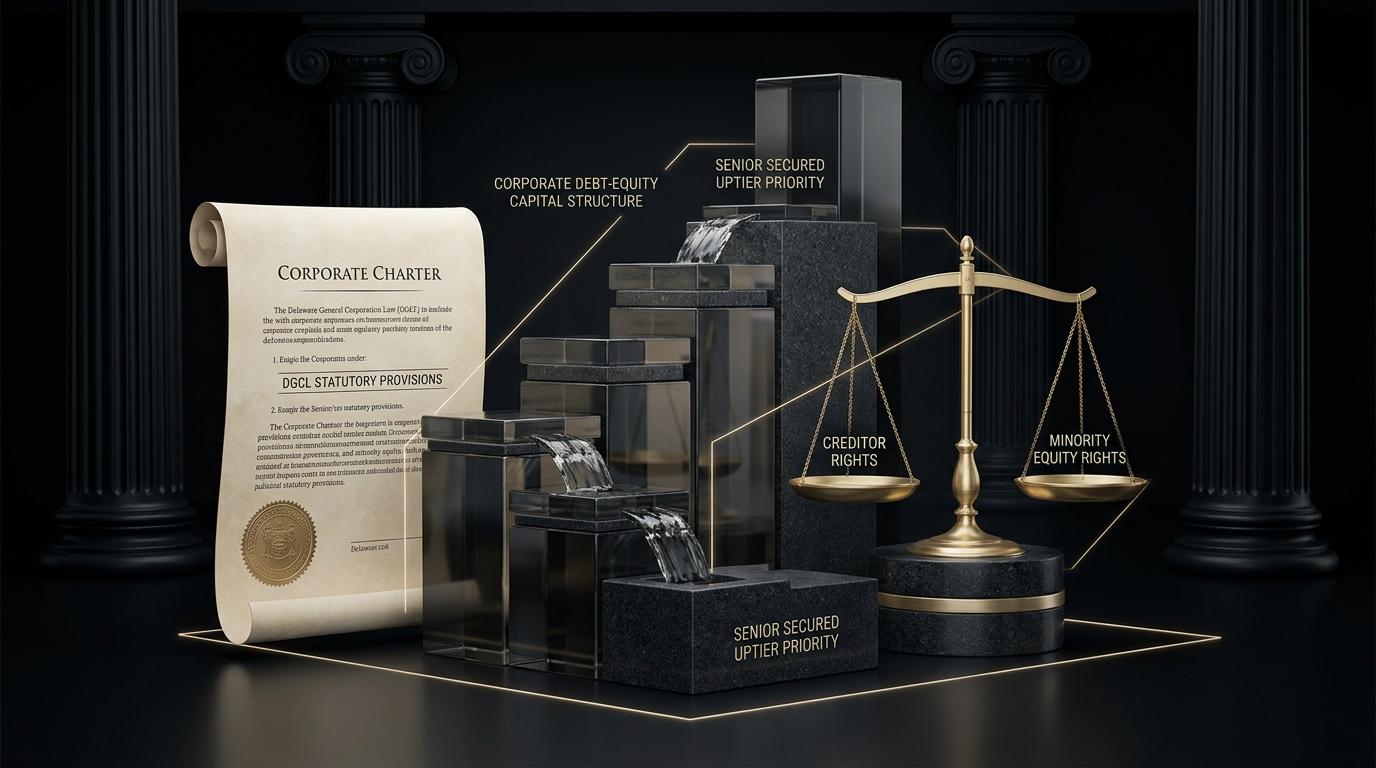
Executive Briefing Memorandum
Vice Chancellor Morgan T. Zurn denied motions to dismiss in consolidated litigation challenging a $14.2 billion non-pro-rata uptier exchange. The Court ruled that majority creditor-sponsors executing coercive exit amendments violate DGCL § 102(b)(7) loyalty standards, establishing that private credit liability management remains vulnerable to direct shareholder fiduciary review.
Judicial Landmark: Delaware Court of Chancery C.A. No. 2025-0814-MTZ
In a transformative memorandum opinion delivering immediate shockwaves through private credit syndicates and sponsor-backed restructuring advisory desks, the Delaware Court of Chancery refused to dismiss direct claims brought by minority equity holders and junior debtholders challenging a $14.2 billion aggressive uptier debt-equity restructuring.
Presiding Vice Chancellor Morgan T. Zurn held that private equity sponsors controlling a borrower board cannot utilize majority-creditor consent mechanisms to strip sacred rights from excluded stakeholders while shielding themselves behind contract-only defenses. Where an uptier transaction transfers substantive enterprise value directly to preferred sponsor-affiliated lenders at the expense of common equity, Delaware courts will scrutinize the transaction under the rigorous entire fairness standard.
The Anatomy of Non-Pro-Rata Liability Management Under Fiduciary Scrutiny
The disputed restructuring involved a syndicated capital structure where sponsor-controlled entities acquired a slim 51% majority in senior secured tranches. Acting via non-public written consent, the majority coalition amended credit indentures to subordinate existing non-participating lenders into 'super-junior' status while granting new first-out super-priority liens exclusively to themselves:
- Coercive Exit Amendments: The majority stripped negative covenants, asset-sale restrictions, and pro-rata sharing provisions from the base credit agreement without affording minority participants an opportunity to participate on ratable terms.
- DGCL § 102(b)(7) Invalidation: The Court held that exculpatory charter clauses under 8 Del. C. § 102(b)(7) cannot immunize director defendants where the restructuring confers an asymmetric economic extraction to controlling sponsor affiliates, pleading an incurable breach of loyalty.
- Direct vs. Derivative Dichotomy: Applying the landmark Tooley framework, the Court categorized the shareholder dilution and covenant stripping as direct injuries, bypassing demand excusal hurdles under Chancery Court Rule 23.1.
Private Credit & Wall Street Advisory Implications
Vice Chancellor Zurn's ruling marks the end of unchecked 'creditor-on-creditor violence' executed under Delaware corporate umbrellas without fiduciary consequence:
- Enhanced Intercreditor Negotiation: Sponsors and steering committees can no longer rely purely on literalist interpretations of New York contract law when the borrowing entity is incorporated in Delaware and board members overlap with favored lenders.
- Board Special Committees for Restructurings: Borrowers contemplating non-pro-rata exchanges or drop-down liability management transactions must institute independent restructuring committees with unconstrained veto authority.
- Valuation and Solvency Opinions: Direct exposure to entire fairness creates urgent requirements for contemporaneous fair-value fairness opinions before consummating distressed recapitalizations.
Verifiable Primary Sources & Official Dockets
| Regulatory & Judicial Field | Official Filing Record | | :--- | :--- | | Presiding Forum | Court of Chancery of the State of Delaware (Wilmington, DE) | | Presiding Jurist | Morgan T. Zurn, Vice Chancellor | | Formal Docket Number | C.A. No. 2025-0814-MTZ (In re Apex Global Restructuring Shareholder Litigation) | | Filing Classification | Memorandum Opinion Denying Rule 12(b)(6) Motion to Dismiss (54 pp.) | | CourtListener RECAP Archive | Delaware Chancery Official Docket Repository |
Institutional Placements for Corporate Practices & Investment Banks
Reach General Counsel, M&A directors, and private credit allocators across Wilmington, Wall Street, and the City of London.
Inquire for Syndication Placements →