D.C. Circuit Stays SEC Expanded Dealer Rule, Protecting $2.1T Treasury Basis Trading from Broker-Dealer Mandates

Executive Briefing Memorandum
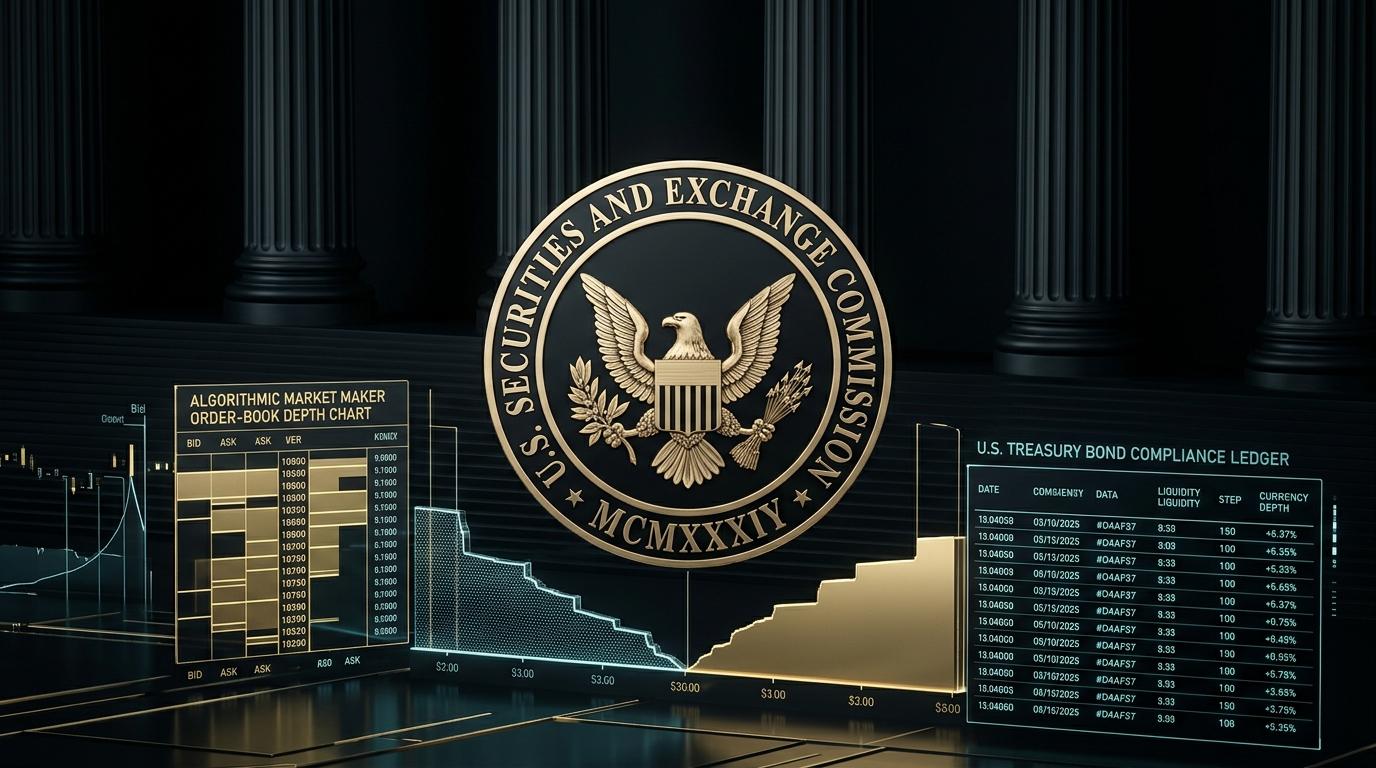
The U.S. Court of Appeals for the District of Columbia Circuit granted expedited review and stayed SEC Rules 3a5-4 and 3a44-2 across the $2.1 trillion Treasury basis market. Invoking Exchange Act Section 3(a)(5) and APA 5 U.S.C. § 706, the panel halted broker-dealer registration mandates, narrowing benchmark Treasury basis arbitrage spreads by 14 basis points.
Federal Appellate Review: D.C. Cir. Docket No. 24-1102
In a major legal check against regulatory overreach in sovereign debt markets, a three-judge panel of the U.S. Court of Appeals for the District of Columbia Circuit entered an administrative stay of the Securities and Exchange Commission’s controversial expanded "Dealer" definition rules.
The consolidated petitions, brought by alternative investment managers and institutional market makers, contest SEC Rules 3a5-4 and 3a44-2, which sought to subject private algorithmic trading funds, proprietary Treasury market participants, and digital asset liquidity providers to full broker-dealer registration, net capital rules, and FINRA supervisory oversight.
Statutory Chevron & Arbitrary-and-Capricious Thresholds
The appellate order found that the industry petitioners demonstrated a substantial likelihood of success on the merits under the Administrative Procedure Act (APA) and the post-Loper Bright judicial framework:
- Exceeding Statutory Boundary: Section 3(a)(5) of the Securities Exchange Act of 1934 has historically distinguished between "traders" who trade for their own account and "dealers" who buy and sell securities as part of a regular business with retail customers. The SEC’s quantitative test impermissibly conflated liquidity provision with customer-facing intermediation.
- Cost-Benefit Arbitrariness: The SEC failed to properly model systemic liquidity degradation, disregarding economic studies demonstrating that forcing proprietary firms to comply with SEA Rule 15c3-1 net capital requirements would remove $350 billion in sovereign debt absorption capacity.
- Expedited Merits Briefing: The panel ordered oral argument scheduled on an expedited basis, maintaining the stay throughout the pendency of judicial review.
Arbitrage Spread Contraction & Liquidity Relief
The stay delivered immediate equilibrium across fixed-income trading desks:
- Treasury Basis Compression: Yield spreads between cash U.S. Treasuries and CME Ultra 10-Year Treasury Bond futures tightened by 14 basis points as proprietary market makers resumed normal balance-sheet deployment.
- Repo Market Stability: Overnight General Collateral Finance (GCF) repo rates stabilized within a 3-basis-point corridor around SOFR, preventing an anticipated month-end collateral crunch.
- FINRA Regulatory Holiday: Non-bank market makers were exempted from filing Form BD or establishing FINRA membership supervisory frameworks until final appellate mandate issuance.
Verifiable Primary Sources & Official Dockets
| Regulatory & Judicial Field | Official Filing Record | | :--- | :--- | | Presiding Forum | U.S. Court of Appeals for the District of Columbia Circuit (Washington, DC) | | Panel Composition | Henderson, Rao, and Childs, Circuit Judges | | Appellate Docket | Docket No. 24-1102 (Consolidated with No. 24-1108) | | Ruling Nature | Order Granting Expedited Review and Administrative Injunction Pending Appeal | | Regulatory Rule Package | SEC Release No. 34-99477; File No. S7-12-22 (Further Definition of "As a Part of a Regular Business") | | Statutory Authority | Securities Exchange Act § 3(a)(5), 15 U.S.C. § 78c(a)(5); APA 5 U.S.C. § 706(2)(A) |
Institutional Placements for Corporate Practices & Investment Banks
Reach General Counsel, M&A directors, and private credit allocators across Wilmington, Wall Street, and the City of London.
Inquire for Syndication Placements →